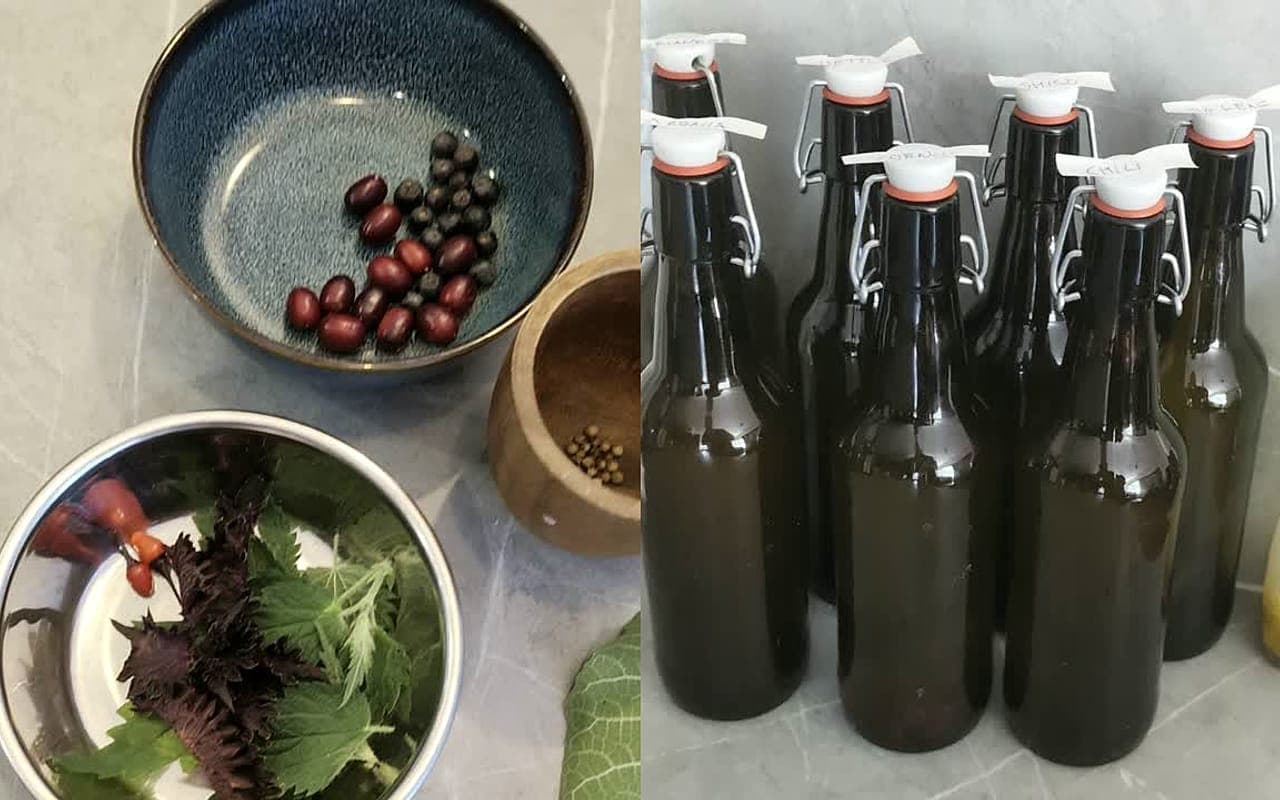
8 bottles, 8 garden flavours: running second ferments side by side without losing track
“What should I put in my F2?” Lists of ideas are everywhere: ginger, lemon, berries, mint. The trouble is that a list can't tell you what you will enjoy, with your water, your grains and whatever grows near your door. The only way to find out is to taste — and the fastest way to taste a lot is to test several flavours at once, on one single base.
That's exactly what I did in August: four litres of water kefir, eight bottles, eight flavourings picked from the garden on bottling morning. Here's the method, then the verdicts — including the ones that surprised me.
Why test side by side instead of one flavour at a time
Test one flavouring per batch and each trial lands a week apart, on a different base: a slightly longer F1, a slightly warmer room, grains in better or worse shape. When you compare last Tuesday's result with today's, you're not comparing two flavours — you're comparing two entire fermentations.
Split one base across several bottles and everything upstream of bottling is identical by construction: same water, same sugar, same F1 length, same grains. Only one variable is left, the flavouring. What you taste is genuinely it.
It's also the cheap way to learn: one four-litre F1, one jar to clean, and eight answers instead of one.
The method in five points
1. One base, made normally
Nothing exotic. My F1: 4 litres of tap water at room temperature, 120 g of cane sugar (30 g/L), 120 g of grains (30 g/L), 2 dried figs for minerals (one per two litres) and a lemon. Started 9 August at 19:16, grains removed 13 August at 11:20 — 3 days and 16 hours.
The 30 g of sugar per litre is deliberately low: plenty of recipes call for 50 to 80 g/L. Less sugar at the start means less leftover sugar at bottling, so less pressure in the bottle. On acidity, I measured pH 4.4 at mixing and 3.1 when the grains came out, comfortably under the 4.6 safety line.
2. One variable per bottle
One flavouring per bottle, and nothing else that differs. Add priming sugar to one bottle and not the next and you're no longer comparing flavours, you're comparing carbonation. In my case: no priming sugar anywhere — I prefer my drinks still. As you'll see, it didn't go quite to plan.
3. Label them, immediately
Eight bottles of cloudy liquid all look alike after two days. A label on every bottle, written as you fill it: it's the one step you can't fix afterwards.
4. Date them
The bottling date, the same across the batch, is what later lets you say “four days in the bottle” instead of “a few days”. Without it, your verdicts are comparable neither with each other nor with your next series.
5. Taste on a fixed date, and write the verdict down
The step everyone skips. An opinion you forget was worth nothing: it's the logbook, not the tasting, that turns an experiment into knowledge. One line is enough — the flavouring, the number of days, how it tastes, and whether you'd do it again.
One tip: open everything on the same day and you compare eight flavours but a single duration. Open in two rounds a few days apart and you get a sense of what time does, for free.
The story: four litres, eight bottles
Bottled on 13 August, with eight flavourings picked that morning: coriander seed, nettle, shiso, fig leaf, chilli, cornelian cherry (cornus mas), aronia and mirabelle plum. Four of them I had never tasted in a drink: the aronia planted last year and never picked, nettle I'd never tried, cornus mas I only knew as jam, and fig leaf only by reputation.
First round opened on 17 August, after 4 days in the bottle. Second round on 22 August, after 9 days, mostly spent in the fridge.
| Flavouring | Opened | Verdict |
|---|---|---|
| Fig leaf | 4 days | The surprise of the batch: a piña colada taste, that coconut note fig leaf is known for. |
| Mirabelle plum | 4 days | Incredibly fruity. |
| Nettle | 4 days | The least memorable of the three — which is not the same as bad. |
| Cornelian cherry | 9 days | Clearly the best of the three. |
| Aronia | 9 days | It's good, but you don't really taste the fruit. |
| Chilli | 9 days | You get the heat on the nose, you barely taste it. |
| Coriander seed | Good, but the flavour stays faint — most likely too few seeds, or crushed too coarsely. | Good — dose it up next time. |
| Shiso | “Incredible” — the revelation of the batch, the one I did not expect. | The favourite of the eight. |
The last two, tasted later: shiso is the revelation of the batch — “incredible”, by a distance — and coriander seed is good but faint, most likely too few seeds, or crushed too coarsely to release their aroma. They'll get their line in the logbook too.
A word on quantities: I didn't record them, bottle by bottle. Which is precisely the mistake the method above is meant to prevent — I can tell you fig leaf works, I can't tell you how many leaves. The next series gets weighed.
What eight bottles taught me
pH tells you nothing about leftover sugar
With no priming sugar, I expected eight still bottles. The fig leaf and the nettle still poured with a proper head of foam: there was sugar left in the base, despite an F1 of nearly four days and a pH down to 3.1.
The lesson fits in one line: pH measures the acid produced, not the sugar remaining. A properly sour base can still hold plenty to carbonate with. Never infer one from the other — and always treat your bottles as if they were under pressure.
Foam probably tracks the fruit's sugar
In the second round, the cornus mas gave the biggest foam and the chilli the smallest. My hypothesis — and I offer it as one, I never measured the bottles' pH: it follows the sugar the flavouring brings along. Cornus mas is the sweetest of the batch, chilli contributes almost none. That fits the basic fact that sugars, wherever they come from, are what makes the bubbles.
A loud aroma can vanish on the palate
The chilli is the perfect example: the heat is there as you bring the glass up, and nearly absent once you drink. The fig leaf — the one I'd picked purely on reputation — gave the most spectacular result of the lot. No list of ideas online would have told you which of the two would work in your kitchen.
Fermenter's note. What I enjoyed most about this series is that four of the eight flavourings were complete unknowns to me as a drink: the aronia I planted last year and never picked, the nettle I'd never tried, the cornus mas I only knew as jam, the fig leaf I'd merely heard about. Out of those four, cornus mas and fig leaf became obvious keepers. I also filmed the F1 as a timelapse — one photo every 15 seconds for 48 hours, 11,520 frames — which changes nothing about the taste, but makes the waiting far easier.
Safety: opening eight bottles without a mess
A parallel series multiplies the bottles, and therefore the chances of getting it wrong. Two habits are enough:
- Chill the bottle before opening. Cold dissolves CO₂ back into the liquid and calms the pressure.
- Open over a container, slowly, releasing the pressure in stages if needed.
And remember the lesson above: “I didn't add priming sugar” is no guarantee there's no pressure.
Going further
If you're wondering how long to leave those bottles before opening, that has its own article: how long the second fermentation of water kefir takes. And to estimate the carbonation you're heading for given sugar and temperature, the F2 carbonation calculator is free and needs no account.
Eight bottles, eight records
The one real risk of a parallel series is ending up nine days later with eight bottles and no memory of what's in them. In FermPal, you split a batch into lots — one per bottle — and each lot keeps its own date, phase, tasting and note, from bottling to final verdict.
Track my ferments with FermPal (free) →
Go further: the complete water kefir guide (grains, F1, F2) and how to track multiple ferments at once.