Plum water kefir with three herbs: Greek basil, violet basil, rosemary — and a lesson in foam
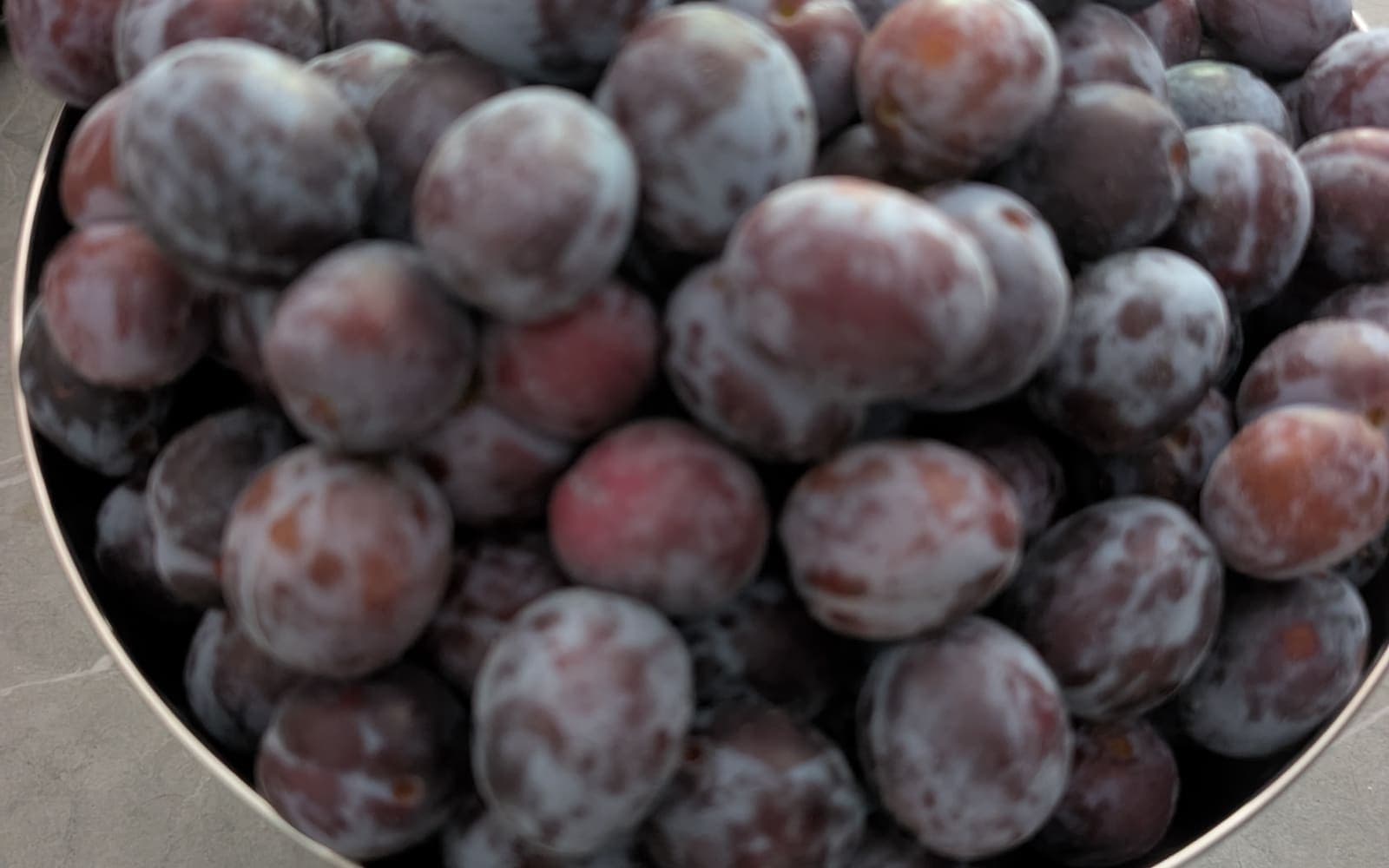
On 1 August I picked 2.855 kg of plums in the garden. A little under three kilos on the scale, in a bowl, gathered that morning: the sort of haul that lands on you when a plum tree decides it is time. And the next question is always the same — what do I do with them before they turn?
Answer: water kefir. Seasonal fruit in a second fermentation is the simplest, highest-return move of the summer. To avoid ending up with three identical bottles, I put a different herb in each one: violet basil, Greek basil, rosemary. A week later, opening them gave me two answers: a very clear ranking of flavours, and a flooded table.
What I recorded, and what is only a guideline
Let me say it up front, because it is part of the story. What I wrote down: the weight of the plums (2.855 kg), my usual base, bottling into three bottles in early August, tasting on 8 August. What I did not write down: how much plum went into each bottle, the exact length of the second fermentation, the herb doses.
I am not going to reconstruct them after the fact. So the numbers below come in two flavours: what I actually did, and general ranges from the literature, given as guidelines so you can run the experiment at home. Which is, incidentally, the moral of this article.
The base: a low-sugar water kefir
Nothing exotic — this is my everyday first ferment: unchlorinated water, 30 g of sugar per litre (that is low; plenty of recipes go to 60-80 g/L), the kefir grains, a dried fig and a slice of lemon. Once F1 is done and the grains are strained out, on to the next step.
Low sugar gives a drink that is not sweet, which is what I want. In theory it also leaves less fuel for the second fermentation. As we will see, that prevented absolutely nothing.
Plums in the second fermentation
The principle: the garden plums go into a second ferment with the strained kefir, in sealed bottles. Plums washed, pitted, cut — stones removed, always, they bring nothing good.
General guideline (not my measurement, I did not record it): the water kefir literature puts fruit additions in F2 at roughly 100 to 300 g per litre. Around 100 g/L the aroma stays discreet and the drink clear; around 300 g/L the flavour is bold, the liquid cloudy, and the fermentation distinctly livelier. Ripe plum is loaded with simple, immediately available sugars: gram for gram it pushes harder than raspberry or a knob of ginger.
Timing: a water kefir F2 usually plays out over 24 to 72 hours at room temperature — I broke down the three variables that move that number in the article on how long an F2 takes. With sweet fruit, in the middle of August, in a kitchen that never really cools down at night, you want the bottom of that range. I did not stick to it.
Three herbs, one bottle each
Same base in all three bottles, one extra herb in each, all bottled the same day. That is the only honest way to compare: one variable, everything else identical. Tasted on 8 August.
| Herb | What it gives | Ranking |
|---|---|---|
| Greek basil (green, small leaves) | A light lemony note, fresh, riding alongside the plum without covering it | 1st — the best of the three |
| Violet basil | Rounder, more assertive than the Greek; the pairing works well too | 2nd |
| Rosemary | You can barely taste it; that bottle is also the lightest of the three on the palate | 3rd — the least interesting |
The result is counter-intuitive. On camera, before opening, I said of the rosemary: "I hope they will not be too strong." It turned out to be the shyest of the lot, almost to the point of being pointless. Meanwhile the little Greek basil, the one I expected nothing spectacular from, delivers exactly what you want in a plum kefir: a lemony edge that lifts the fruit.
If you only test one: Greek basil.
The lesson in foam
8 August, opening time. The bottles had been standing still — nobody shook them, carried them or rolled them. The first one overflowed across the whole table before I could pour it into my Erlenmeyer flask — yes, I drink my kefir from an Erlenmeyer, that is my glass. The second went off like a geyser.
It was not an accident, it was predictable. Sweet fruit in a second fermentation, a full week, mid-August, in sealed bottles: there is no other outcome.
Why sweet fruit pushes so hard
Bubbles are sugar turned into CO₂ inside a closed container. My 30 g/L F1 had already eaten most of its sugar — but the plum puts a fresh dose back in, in an already simple form, directly fermentable by the yeasts still living in the liquid. Add August heat, which speeds everything up, and pressure climbs well past what you were aiming for. A low starting sugar protects you from nothing if the fruit you add in F2 does the job instead.
Six habits that keep your kitchen clean
- Shorten the F2 when the fruit is sweet. Plum, grape, fig, ripe pear: aim for 24 to 36 hours rather than three days.
- Use a plastic test bottle. Fill a small PET bottle with the same liquid, seal it, and squeeze it daily: when it is rock hard, the whole batch is ready. A free signal, without ever opening a glass bottle.
- Burp once a day if you run longer: crack it open briefly, close it again. You lose a little fizz and gain a lot of peace of mind.
- Fridge for 24 hours before opening. Cold puts the yeasts to sleep and redissolves part of the CO₂: a warm bottle foams, the same bottle cold simply pours.
- Open over a container, in the sink, slowly and in stages — never in one confident twist.
- Use swing-top bottles rated for pressure, and do not fill them to the brim: leave 3 to 4 cm of headspace.
To turn all of this into a number before you bottle, our F2 carbonation calculator gives an estimate from sugar and temperature.
Fermenter's note. 2.855 kg of plums picked in the garden on 1 August, and no intention of letting them go to waste. A week later my table was flooded before I had tasted anything at all: the first bottle overflowed, the second went off like a geyser, and I had shaken nothing. The flavour verdict, on the other hand, is clear — Greek basil first, violet basil close behind, rosemary far off, barely noticeable. What I would probably do differently: cut the F2 shorter, or move the bottles to the fridge sooner. And above all write the quantities down: the one thing I cannot reproduce exactly is the thing I never recorded.
Doing it again, better
What this story is missing is not a recipe, it is a logbook. Three bottles from the same base only become a useful experiment if each one is tracked as its own batch: bottling date, herb, F2 duration, pressure on opening, tasting verdict. That is exactly what FermPal does — the fermentation logbook that remembers for you, so the next plum harvest starts where this one left off.