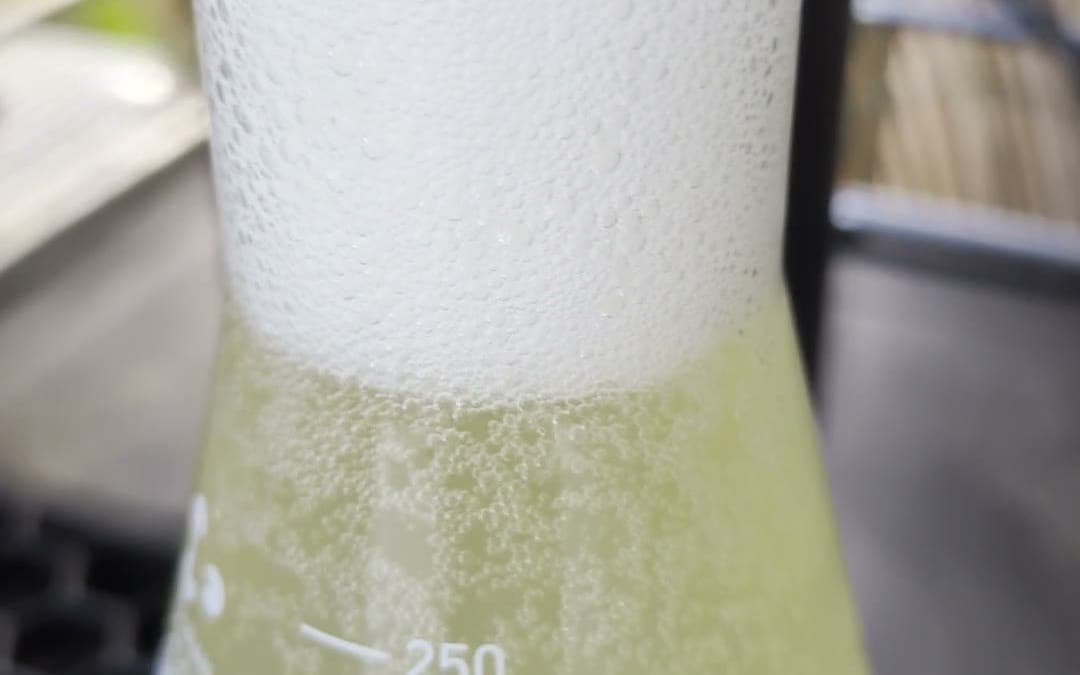
Ginger, turmeric and pepper water kefir: dry, sharp, and it bites
Most ginger-flavoured water kefirs end up as soft drinks: a sweet base, a bit of heat, easy sipping. Not this one. This is a dry, properly sharp water kefir that bites, made with a lot of ginger, a low-sugar base and deliberately long ferments. Here's the recipe exactly as it was brewed, with its real doses — and, more usefully, the reasoning behind them, because that's what transfers to your own jars.
Who it's for — and who it isn't for
Let's be clear up front, it'll save you four litres. This one is for you if you like dry, acidic drinks: a kombucha taken well past sweet, straight lemon juice, a ginger lemonade that scratches on the way down. The ginger is loud, the sugar is nearly gone, the acidity is clean.
It's not for you if you want something soft and refreshing, if you're serving it to children or to guests discovering kefir, or if your stomach doesn't get on with acidic drinks — a kefir taken all the way down drops fairly low in pH, and with this much ginger on top it stays a vivid drink. In that case skip straight to the milder variations below: the same ingredients, dosed differently, give something far more agreeable.
And if what you actually want is a rounder, fizzier ginger drink, this isn't it — that's a ginger beer, with its ginger bug and its own recipe. Different culture, different result.
The base: a low-sugar water kefir
It all starts from an ordinary water kefir, but with the sugar deliberately low. For 4 litres:
- 30 g of cane sugar per litre — where most recipes call for 50 to 80 g/L
- 30 g of kefir grains per litre
- 2 dried figs for the whole 4 litres
- 1 lemon
- tap water
The low sugar isn't a detail, it's the first lever of the dry result. The less sugar you start with, the less is left at the end — provided you let the grains finish the job (more on that below).
The three spices, and their real doses
- Ginger: 30 g per litre. That's a lot. On purpose: this recipe is built to bite.
- Turmeric: 2 g per litre. Fifteen times less than the ginger — it colours the batch and adds an earthy bitterness, it doesn't take over.
- Pepper: 10 % of the turmeric, so 0.2 g per litre. A pinch, literally.
That pepper-to-turmeric ratio isn't arbitrary: it's the classic kitchen pairing, pepper's piperine being reputed to improve the uptake of turmeric's curcumin. It's used here as culinary habit rather than a health claim — and because a hint of pepper stretches the ginger heat nicely through the finish.
Fresh or ground? Both work, but they don't dose the same. Freshly grated ginger gives a bright, lemony heat, and a good share of the stated weight is water; ground, the same weight is far more concentrated, warmer and earthier. Same for turmeric. If you're using powder, start well below the figures above and climb on the next batch — adding is easier than undoing. The spices can go into the F1 with the sugar base, or into the F2 at bottling for a fresher, sharper aroma.
Why long F1 and F2 give you dry AND fizzy
This is the heart of the recipe, and where most people go wrong. Here, both the first and the second ferment ran longer than usual, on purpose.
The mechanism is simple. Yeasts and bacteria eat sugar and turn it into acids and gas. The longer the ferment, the more sugar disappears: the drink gets less sweet and more acidic. That's exactly the goal here. Stretching the F1 makes sure the little sugar there was at the start is consumed to the end, instead of leaving a sweet floor that would round everything off.
The common intuition is that a dry kefir can't be fizzy — since bubbles come from sugar. But the CO₂ doesn't depend on how much sugar is left, it depends on the sugar converted inside a sealed bottle. As long as a little fermentable material is there at bottling and the culture is lively, the F2 makes gas that has nowhere to go. Hence the result: dry on the palate, and still alive in the glass. Nothing to add at serving.
Two safeguards, all the same. First, pressure: a long F2 with an active culture is also the recipe for bottles that overflow. Use swing-top bottles rated for pressure, keep one plastic bottle in the batch as a gauge (hard to the touch means ready), and don't forget to move it to the cold. To settle on a duration, how long the second fermentation of water kefir takes walks through the three variables that move it, and the F2 carbonation calculator gives you a number instead of a guess.
Second, alcohol. Fermenting longer produces slightly more residual alcohol. Homemade water kefir generally stays under 1 %, but it isn't zero — worth knowing before you pour a glass for someone who doesn't drink.
Milder variations
If you want the same idea with the edges filed off, there are two levers — move one at a time:
- Cut the ginger. It's what makes the drink divisive. Halving it (around 15 g/L) gives a spiced but widely drinkable version; turmeric and pepper can keep the same ratio to each other.
- Shorten the F2, and stop the F1 earlier. Less time means more sugar left, so more roundness and less acidity. The trade-off: watch the pressure more closely, because unconsumed sugar is fuel.
You can also nudge the starting sugar back up towards the usual figures. But then own it: it'll be a different kefir, not a softened version of this one.
Fermenter's note. I used far too much ginger, and I let both the F1 and the F2 run longer than usual so the sugar would be eaten right to the end. It comes out dry and properly sharp, not sweet-and-gingery at all. The glass fizzes on its own, with nothing added. It isn't a soft drink and I wouldn't recommend it to everyone — but if you like it to bite, this is exactly that.
A short video of this batch (33 seconds) went up on 7 August 2026 on the YouTube channel — enough to see the colour and the bubbles, if not to taste it.
Brewing the exact same one next time
A recipe like this one lives or dies by its numbers: 30 g/L of ginger instead of 20, an F1 pushed a few extra days, and it's no longer the same drink. These doses and durations were logged in FermPal as the batch went: every batch keeps its phases, durations and ingredients, and every adjustment creates a new version of the recipe — the one that worked stays findable, and the next batch starts from it instead of starting over.